
At some point, learning Chinese stops being “hard” and starts being insulting.
You download another app.
You review the same pinyin chart again.
You tap through flashcards for Chinese characters you’ve already forgotten three times.
You can say “water in Chinese” and “I love you in Chinese” but still can’t follow a real conversation.
And eventually you start wondering whether the problem is you — or the entire way we try to learn Mandarin Chinese.
I’ve lived in Taiwan for a long time. I’ve tried almost every popular “learn Chinese” method: apps, textbooks, spaced repetition systems, pinyin drills, character memorization systems, English-to-Chinese translators, Chinese-to-English tools, podcasts, courses, YouTube channels. Some were fine. None of them actually worked for me in a way that stuck.
What finally pushed me over the edge wasn’t failure.
It was boredom.
Why Learning Chinese Feels So Broken
Most Chinese learning systems focus on the wrong thing first.
They start with Chinese characters — the hardest, least immediately useful part — and treat spoken Mandarin like a side effect. You’re expected to memorize strokes, radicals, and simplified vs traditional Chinese before you can even say something naturally.
But language doesn’t work that way.
No one learns their first language through characters. They learn through sound. Through repetition. Through meaning. Through listening.
Yet with Mandarin Chinese, we often flip the order:
- Characters before speech
- Writing before comprehension
- Rules before intuition
So learners get stuck in an endless loop of:
“I technically studied Chinese, but I can’t actually use Chinese.”
That’s where pinyin is supposed to help — but even pinyin is often taught in isolation, divorced from real listening.
Pinyin Isn’t the Problem. Characters Aren’t Either.
Here’s the uncomfortable truth:
Chinese characters are not evil.
Pinyin is not useless.
Most apps aren’t bad.
They’re just badly sequenced.
Pinyin works when it’s tied to sound you recognize.
Characters work when they represent words you already know.
What doesn’t work is forcing your brain to memorize abstract symbols for words you’ve never actually heard used in a real sentence.
If you already understand spoken Mandarin Chinese, characters suddenly feel logical. Even elegant. But without listening comprehension, character memorization feels like shoveling sand into a sieve.
Why “Learn Chinese Fast” Promises Are Lying to You
Search for “learn Chinese” and you’ll see the same claims over and over:
- Get fluent in 3 months
- Master Mandarin Chinese fast
- Learn Chinese characters easily
- Speak Chinese without effort
Here’s what they don’t tell you:
Fluency isn’t speed.
It’s volume.
Listening to hours of comprehensible input matters more than perfect pronunciation. Seeing thousands of sentences matters more than memorizing grammar rules. Understanding comes before output — always.
That’s why English to Chinese and Chinese to English tools are helpful only if they support listening, not replace it.
Translation is a crutch. Input is the cure.
The Thing That Actually Helped My Chinese
What finally started working wasn’t another app.
It was listening to real, imperfect, native-ish content that I could mostly understand.
Not lessons. Not dialogues written for textbooks.
Just people talking — slowly enough, clearly enough, about normal things.
That’s when something clicked.
I could follow the rhythm.
The filler words.
The way tones blur together in real speech.
It felt less like studying and more like recognition.
That’s when I realized the real problem wasn’t my motivation — it was that most resources never gave me enough comprehensible input at the right level.
Why I Built My Own Chinese Learning Tool
After years of bouncing between Chinese learning apps, I finally accepted something:
I didn’t need more features.
I needed less friction.
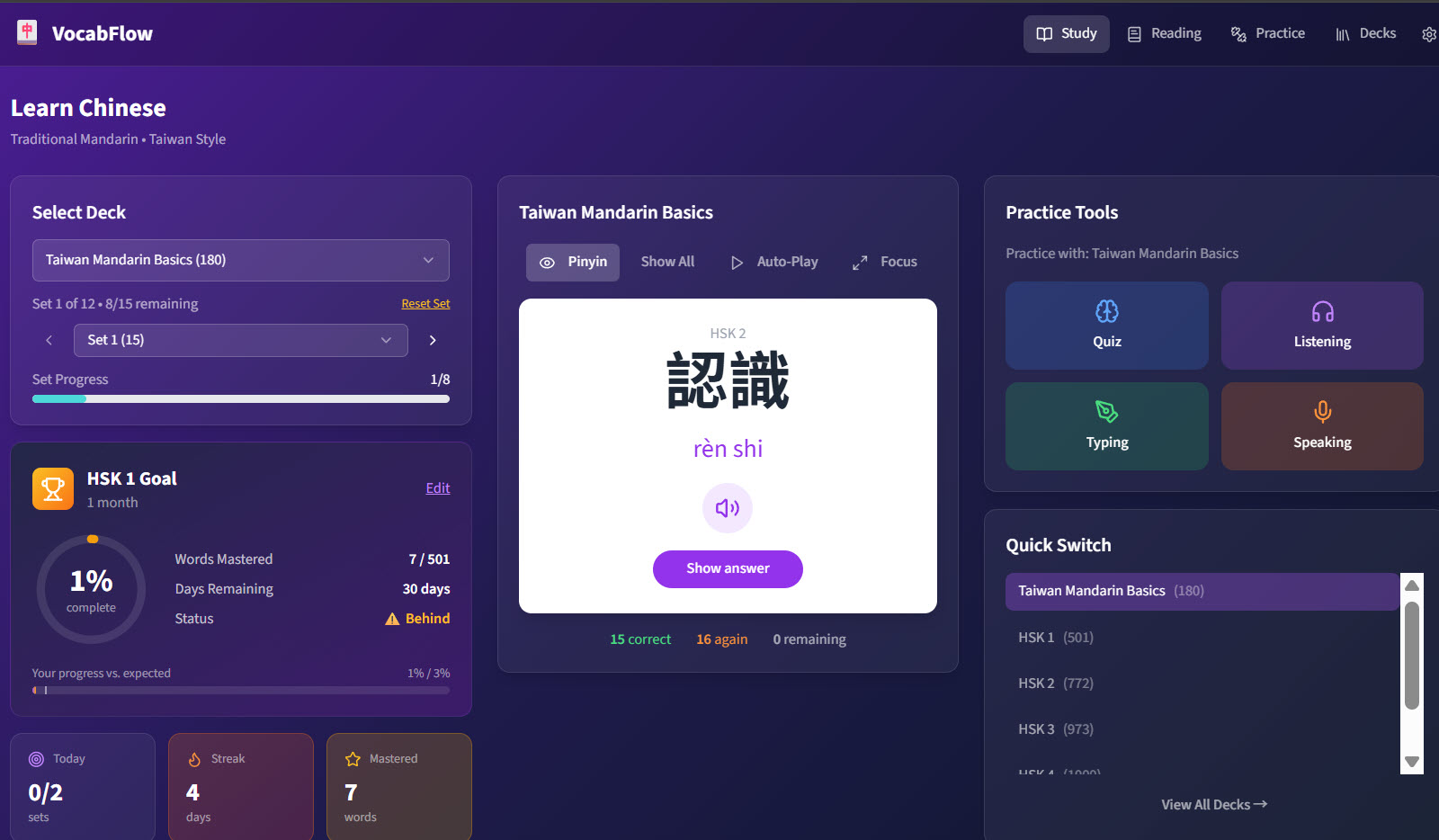
So I built a simple tool that focuses on:
- Listening first
- Pinyin without character overload
- Vocabulary before writing
- Repetition without gamified nonsense
I made it with all the stuff I need, and some accountability and progress tracking. I vibe-coded the shit out of it, but it took nearly 100 hours to get working – and honestly the live AI chat feature is insane for 24/7 conversation practice.
It’s not magic. It doesn’t promise fluency in six months. It just removes the parts that made me quit every time.
And because no app fixes accountability, I paired it with something scarier…
My One-Year Mandarin Chinese Experiment
Instead of “quietly trying again,” I decided to make it public.
I started a YouTube channel where I:
- Speak real English (for English learners)
- Talk about learning Chinese honestly
- Document what works and what doesn’t
- Hold myself accountable to a one-year Mandarin fluency challenge
Some videos are messy. Some are boring. Some are just me thinking out loud. That’s intentional.
Language learning doesn’t fail because people aren’t smart.
It fails because the process is lonely, abstract, and easy to abandon.
Public accountability changes that.
Characters, Eventually — Not First
To be clear: I’m not anti–Chinese characters.
I just refuse to let them block progress.
Once spoken Mandarin feels familiar, characters stop being enemies. They become anchors. They make pinyin clearer. They reinforce memory instead of competing with it.
That’s when learning simplified Chinese or traditional Chinese actually makes sense.
Not first.
Later.
If You’re Still Struggling to Learn Chinese…
If you’ve tried every “learn Mandarin Chinese” method and still feel stuck, it’s probably not a discipline problem. It’s a sequencing problem.
Language isn’t math.
You don’t solve it — you absorb it.
And absorption requires:
- Time
- Listening
- Context
- Patience
I’m not fluent yet. That’s the point.
This is me rebuilding my Chinese learning process from the ground up — with tools and content that don’t make me want to quit.
If you’re learning Chinese too, maybe it’ll help you.
If not, at least it’ll be honest.
If you’re curious, you can check out:
- the Chinese learning tool I built
- or the YouTube channel where I’m documenting this experiment in real time
No promises. No guru nonsense. Just progress, slowly, in public.







No Comments